
A distinctive mirror begins with an idea: a shape that complements a room, a frame that catches the light, or a composition that gives a familiar space a new focal point. A finished piece requires attention to proportions, edges, and reflective details.
For homeowners, interior designers, distributors, and OEM/ODM partners, understanding these details makes it easier to choose a decorative mirror or prepare a useful brief for a custom design.
Concept and composition
Start with the setting. Should the mirror soften a wall of straight lines, echo the curves of a console, or become a focal point in an entryway? Consider the size of the central reflective area, the width of the decorative frame, and the view across the room's usual seating and entry positions.
A drawing or reference image helps convey the intended outline. It is also worth reviewing the design across different distances: a delicate border reveals its detail up close, while a strong silhouette can hold its own across a room.
Why the edges matter
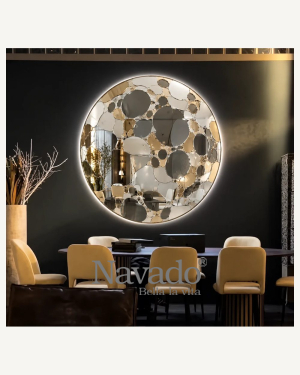
An edge is a small detail with a visible effect. A polished edge gives a clean finish; a beveled edge introduces an angled surface that catches light as the viewer moves. For a composition assembled with individual mirrored pieces, the alignment of neighboring edges and the consistency of the finish influence the overall rhythm.
Ask which edge treatment is available for the specific design. A close-up photograph or sample, if available, can help you evaluate how it appears under the lighting intended for the project.
Craftsmanship and review
Hand finishing allows careful attention to individual pieces and the way they meet. The value of that work is most apparent when the design, reflective elements, and frame feel considered as a whole. Review a proposed sample or detailed photograph with the designer and maker before production, especially when coordinating the mirror with lighting, furniture, or other reflective materials.
For a custom project, confirm the actual dimensions, weight, mounting method, finishes, and installation requirements with the supplier and installer. If a design includes lighting, discuss the electrical requirements for the destination market rather than assuming that one specification suits every location.
Prepare a clear project brief
A practical brief for a designer, distributor, or OEM/ODM partner can include:
- The intended room and the role of the mirror in the space.
- Overall dimensions, preferred shape, and available wall area.
- Drawings or reference images of the desired composition.
- Preferred mirror colors and edge finishes to discuss.
- Expected quantity and destination market.
- Questions about samples, mounting, packaging, and any lighting requirements.
A hand-finished decorative mirror can bring daily function and expressive design together. Explore the NAVADO decorative wall mirror collection or contact NAVADO to discuss a design and confirm the options available for your project.




AAdministratorsAdmin
Welcome, honored guests. Please leave a comment, we will respond soon